Spain Travelogue ‘25 & ‘26: Schools & Shows
Twice in the last two years, I have spent one of summer’s hottest months in Spain. I have no regrets. The study has been rigorous, the shows fantastic, the food and people lovely, the countryside and towns gorgeous. I am here to tell you about it, thanks to FAI and their generous inclusion of my informational ramblings.
I’ll be brief in my reflection on Sept. 2025, as memories have a way of slipping away and I want to focus on August ’26, before time steals too much color from that adventure.
Last year we attended La Academia de Danza de Tamara y Ursula Lopez in Sevilla. My daughter Alishanee was on a scholarship that she won competing in the Flamenco Vivo Certamen ’24 and I tagged along. Rafael Campallo taught a great workshop, and he had his chosen guitarist accompanying, which really brought his choreographies to life. I cannot stress how important this is for me. Since I wasn’t BORN into flamenco, but rather have had to sweat, fight and pay to learn every paso, note and compas, I don’t have the melodies in my subconscious and, to get me where I want to be with new choreographies, I need that sonic help. This guy was brilliant and constant. Would that all other classes had a guitarist!
Later in August, when the lady directors returned to the studio, they began their usual training schedules: The material was very advanced, both footwork and castanets, very complete and correct. The teachers simply brilliant and without mercy. The foreign and Spanish students clearly attend on a long-term basis and must improve markedly. They have a full schedule that includes choreographies, technique, and bata de cola. The cost is reasonable, the two studios decent. It is located sort of on the edge of the Casco Antiguo, near La Alameda, El Torneo y La Macarena. The dressing room is a cramped, sweaty abomination, but, hey, one must suffer to pay their dues, right? I would advise trying to lodge close by, as my my body was further stressed by our half-hour walking commute.
As Sept progressed, we decamped to Jerez and one of the most beautiful historic homes in which I have ever had the privilege to live, located near the Cathedral. For ten days we enjoyed this gem, while studying at the studios of Chiqui de Jerez. Chiqui’s classes are lower cost than many other’s, but still of a good high quality. Intermediate classes covered Bulerias and Caña. The advanced classes seemed to mostly be comprised of local teenagers learning a Martinete with baston. Great, tasty, straightforward material, taught clearly, sometimes with advanced students demonstrating. No guitarist, but good recorded music and on Friday there was a very good singer. Our classmates were friendly and easy-going, and of every stripe, Jerezanos and Europeans of all ages, shapes, sizes and genders. I would definitely enjoy returning to Chiqui’s school. She is sweet, relaxed (rarely buckles her shoes) and approachable, going immediately after class into her street front patio to smoke.
Tablaos: In Sevilla we went to Los Gallos, where Rafael Campallo was performing. The club was woefully empty-ish, I think there were only about 15 people in attendance, maybe due it being the off-season of August? Rafael was fantastic, with his same guitarist, the Sra. that has been there forever (Samara?) was stately and authentic and the younger female dancer accomplished. The THREE singers were EXCELLENT, and the other guitarist very, very good. Cost was reasonable, including one drink as is standard in all the tablaos these days.
We also went to the Tablao Las Setas, under those horrible modern structures marring the beauty of La Plaza Encarnacion. While they DO provide shade, I personally do not care for them, and I think they should’ve spent that money planting trees. The tablao itself was also predictably modern, with lots of neon lights decoration; it looks a lot like an American disco, circa 1980’s. But the show itself was extraordinary: Mara Rey and El Lavi singing, El Perla on the guitar and Belen Lopez absolutely scorching the stage, with a couple of pretty accomplished chicas using batas and props to round out the presentation.
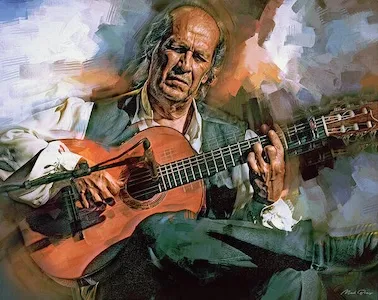
The best show we saw was the Fall ‘25 opener of the Peña Torres Macarena. Horribly hot and cramped, but we were treated to a big family group from Jerez led by the figura Manuela Carpio, that also included cantaor El Lavi, who was much more agusto in this setting. Here, unlike at Las Setas, he wasn’t forced to duck a dancer’s bata de cola, but was prominently featured, as is proper. (There is a good review of this show on ExpoFlamenco: link below. Humorously, a critic mentioned Sra. Carpio’s costume, which evoked a salad - so rare in Andalusian cuisine! I agree with Kiko Valle; her interpretations were soulful and spare, without the crazy endless (boring to me) footwork so popular these days, simply offering her seasoned embodiment of classic flamenco.
A note about my dear Sevilla, where I lived for 6 months in the year 2000, on scholarship at the Fundacion de Flamenco Cristina Heeren. It has changed a lot: it’s more tourist-ey and commercial. It IS a shopper’s paradise. The only place where I found a fabric store that sold flamenco dress patterns: Mercys, C/Cuna, 33. Nearby, we enjoyed the most fascinating store ever: Jaki, C/Puente y Pellon, 3, where you can find every hair comb, earring, flower, bead, headdress, or trimming, in any color, shape or size. Years ago, when I worked for Calzados Menkes, Sr. Menkes wisely wanted nothing to do with the Chinese market. Indeed, by seeing this store it’s obvious that these goods are made more cheaply than any Spanish manufacturer. Jaki sold a madroño trim for 8 EU per meter, at Mercys a higher quality madroño trim was 16 EU per meter, made with a natural fibre, perhaps silk or cotton and it hung beautifully, while the one at Jaki was stiffer and seemed possible to wrinkle.
Of course, lodging is fancier and more expensive. But there is a huge range of quality: my advice is try to avoid booking sight unseen. We mistakenly booked two nights at a miserable pension Perez Montilla. It was clean, had hot water and Wi-Fi, but my single room (cell) was minuscule, with one tiny window and cost 60. The cute patio in the picture on booking.com does not exist, or if it does, I certainly didn’t see it. The patio has been cannibalized to install an elevator and my sad little room. Just a few blocks away, the charming Hotel Patio las Cruces maintains their quality, with a big open courtyard full of plants and $71 for a single room.
Now, on to 2026! This year we journeyed in August, we are very daring because: Hotter! Thanks to Carmela Greco for Alishanee’s scholarship,
our first sojourn was in Cadiz, which is notoriously about 10 degrees cooler than inland Spanish areas, and the peninsula definitely lived up to that forecast. This is a beach town and EVERYONE, everywhere, is always toting their beach chairs, umbrellas, etc. Be sure and bring your brightest, most summer-ish clothes, plenty of hair-clips, jewelry, bathing suits, cover-ups, and flip-flops, because that is what’s happening! The beach was mobbed daily, ALL the Gaditanos seem to love it; and not only was all of middle-class Spain present, but so were many European and American tourists. Getting a random single night at a hostal was impossible.
Carmela Greco’s Seminario takes place annually from the 1st to the 15th of August. It’s not cheap: 1450 EU, but that works out to about $19 per class and it also covers your lodging. We shared a modern 7th floor apartment with a lovely young lady from the Basque region, with 3 Bedrooms and 2 Bathrooms. Our apartment was towards the back end of Cadiz, on the edge of the industrial port zone, far from the quaint, historical area. But the AC was strong, we were very close to the beach, and had convenient access to public transportation (or a 20 minute walk to the studios), restaurants and food markets. Old-school Spain it was not. The lodging alone was 800 EU each (!) and my daughter and I soon decided that when we return, we will try and find our own rooms and not take quite so many classes.
The schedule was WAY too much for me, and even for my 29-year-old daughter, who is a very strong, trained dancer. FOUR hours daily, and alternating teachers, so the professors that one has on Mondays, Weds and Fridays, are not the same as the ones provided on Tuesdays and Thursdays! That could add up to EIGHT choreographies! My brain cannot hold that much information (especially when baked by the sun), maybe when I was 18 it could’ve, but I have my doubts. Mercifully, a few of the classes were technique only: Lola Greco’s more classical style with castanets and manton taught by dear Carmela and the wonderful Martha Ortiz. I soon decided that 4 hours a day wasn’t possible for me and my swollen feet and I cut it down to 3 daily, in spite of having paid full price. Some dancers seem to come and attend only their preferred teacher’s classes, and that is what I will do next time. Carmen Ledesma, Alejandro Granados, Rosario Toledo, Lola and Carmela Greco, Jesus Fernandez and Jesus Fuentes and my favorite, a very charming Claudia Cruz, “La Princesa de Cadiz”, all taught wonderfully. Our favorites were Claudia’s sassy Tangos de Malaga, Jesus Fernandez gave some great Bulerias, and we enjoyed Jesus Fuentes’ sensitive work on balance, turns and musical interpretation. Some teachers that were announced weren’t able to attend after all, but there were conferences, lectures and transportation to a special party at Carmela’s summer rental finca near Jarana with a swimming pool (!) and a giant paella. There was chilled water, fresh fruit and energy bars provided daily, a dressing space with places to leave your gear, and plenty of room in the class studios, although the plywood floors weren’t great; they were pretty hard on my mantons.
Extra-curricular activities included seeing Manuel Gago sing as part of Festival de Patrimonio, Flamenco 2026 the summer program Los Balcones de Cadiz, eating at our favorite neighborhood (Gallego) restaurant “A Lagoas”, hiking all over the fortress/castle of San Sebastian and watching the solar eclipse from Victoria Beach. Everyone applauded! I love it! Did I mention siestas? Definitely obligatory! You are a FOOL if you don’t stick to a strict habit of post-class eating, showers and slumber, and that goes for all of Spain, at least during hotter weather.
There was a show at Peña Perla de Cadiz featuring Carmen Ledesma and Carmela Greco, but it was under-rehearsed and, I felt, contained a few missteps. They included a wonderful pianist accompanying Mari Peña’s daughter (Manuela?) and another (male) vocalist singing some coplas or cuples (I’m not an expert at telling the difference between these). But when the show switched to a more traditional flamenco format, the pianist couldn’t match the notes and he resorted to playing palmas. Now, I’m not perfect, but the palmas were uncomfortable. The cuple singer was unskilled on that front and didn’t seem to show respect to the legendary Sras with whom he shared the stage. I felt for the guitarists, they gave it their all (the great guitarist Antonio Moya, especially, should’ve been featured more prominently) but the show’s progression just wasn’t well-planned. The strong, young buck sensation El Oruco is… not my cup of tea; his footwork is incredibly complex and fantastically musical, but I don’t find him gracioso- I much prefer male dancers like Pepe Torres or Joaquin Grilo. When the two ladies shared a Solea, things went well enough, and the fin de fiesta was amazing; about 20 gitanas, all gorgeously dressed, coiffed and beautifully made-up, rushed to the stage to show off their patadas. That was when Manuela sought out her mom Mari Peña, the spectacular cantaora from Utrera (and Tony Moya’s wife), to crank out the 500 letras de Bulerias all those beauties needed so that each would get their turn to shine.
Sra. Ledesma directed the show; she doesn’t like to rehearse. Sra. Greco is less improvisational and gamely co-operated, but the manton they gave her to manage was huge and heavy, the Peña was roasting and I don’t know how they can cope in those dressing rooms! It’s like 5000 degrees in there and nary an electric fan in sight. The building is historic and so it is prohibited to install AC. Also FYI - it is cash only and the closest ATM is on the other side of the peninsula. Ha ha ha!
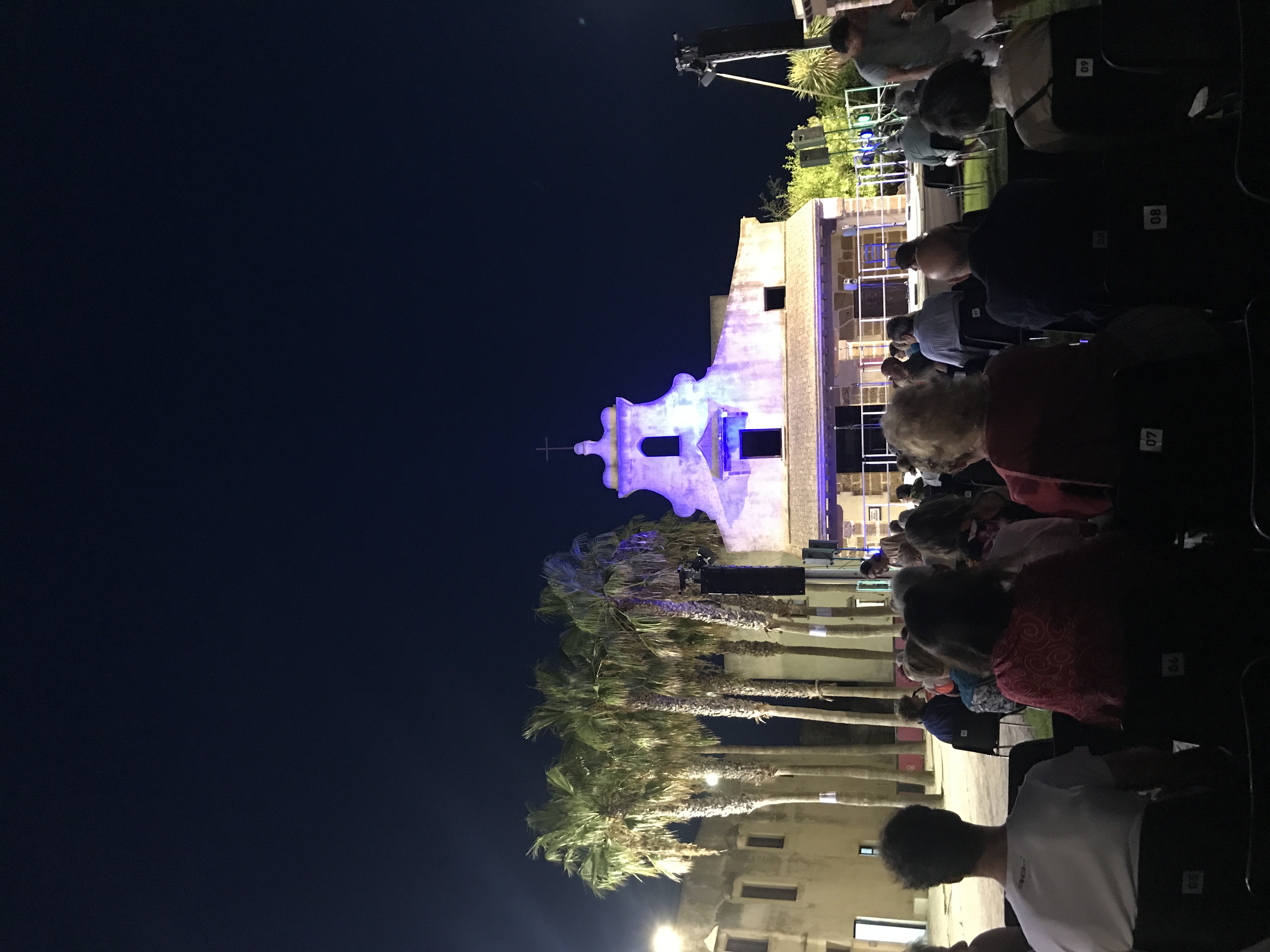
We also saw Jose Maya perform as part of the Cadiz Festival de Patrimonio at the historical Castillo de Santa Catalina. This dancer, whom I’ve twice seen perform in the States, is truly a master; his footwork, timing and turns are impeccable, but what really makes him compelling is his almost spiritual interpretation of his dances. He is possessed, mesmerizing, his body seems to ache, his arms call and beseech the heavens, or towards any source of socorro, though his power needs not any physical help. He is unencumbered by fancy costumes, cleanly supported by the delicate, yet solid, guitar of Jesus Rodriguez and the very finest trio of singers anyone could ask for (one, Ismael de la Rosa “El Bola”, the son of our very own Ismael Fernandez of Los Ricos, NYC). In addition to this star dancer, for the first time I heard the impressively savage Jerezana, Maria La Terremoto, whose cante tore a hole in my heart that will never heal. Unfortunately, if one isn’t in the front section of this flat outdoor venue, one won’t be able to see well, so many folks ended up standing-sacrificing their own comfort to witness the greatness onstage.
Somehow we ended up in Jerez for a few nights and enjoyed the show at El Tabanco Pasaje, as we did last year. This time we sat at a table, like señoritos, and consumed our allotted plates of sliced meats, marinated artichokes, chilled, dry Jerez sherry and wonderful cheese toast with caramelized onions and vinaigrette: the package deal for three cost $105. The show was decent, but the artists seemed a bit burnt out - it IS three shows a day, the venue is ROASTING, the stage small and the pay is not great. It was the same dancer as last year, she is charming and skilled, and the singer warmed up to his role. I enjoyed the show. But the best, REALLY serendipitous thing that occurred in Jerez was on one of our paseos that Saturday night - we ran across a few locals jamming in a street-side cafe, La Bien Paga. They were really good and just doing it for each other, for the fun of it. The real deal and not over-worked and under-paid. I need to spend more time in Jerez.
On a side-note: in Jerez I found a folder advertising the Centro de Baile Cursos de Verano, info offered at www.academiadebailejerez.com. Four weeks of classes with superstars: Pilar Ogalla, Karime Amaya, Manuel Liñan and Marco Flores. They also offer a “Formacion Profesional: baile flamenco para desempleados”, a completely FREE course for the unemployed of Spain: 900 hours from June to January, taught by well-known dancers, and workshops with the stars mentioned above! Funded by SEPE, Servicio Publico del Empleo Estatal, one must prove that they are a jobless Spanish citizen and be selected by audition. What an opportunity! Next time in Jerez, I’ll need to check out this Centro.
On to Granada! The name means pomegranate (which I did not know) and, being the symbol of the city, these ruby images, souvenirs, and pomegranate sculptures are everywhere. One of the most beautiful cities in Spain, Granada is full of ancient Moorish architecture and home to many Gitano flamenco dynasties. Close to lovely beaches in the province of Malaga (1.5 hour’s drive), it also features proximity to mountains high enough to get winter snow. More cosmopolitan than Sevilla, Jerez or Cadiz, it boasts universities, monuments, museums, cinemas, dozens of tablaos and several renowned schools of flamenco. The population, or maybe the tourists, are decidedly more Arabic and/or Muslim, I saw many more women wearing hijabs, and we dined at an excellent Moroccan restaurant.
Although it wasn't a crowded, high-season time of year, the Cuevas did have a nice sense of community, which was pleasant. The school seemed to cater to a more beginner level and was responsible (almost too much; are we accustomed to having to find things out on our own?) in that they took very good care of us, kept us informed on current flamenco events, classes ran on time, teachers were very professional and the classes very rigorous. The space was clean and well-lit, not air-conditioned, but plenty of fans and cool even in the heat of the day (unless you are dancing), and although we didn't spend much time on them, the public terrazas looked really nice. One can smoke on the terraces, if need be. There is also a Jam Session every other Thursday, where everyone is encouraged to show off their skills in a very low-pressure setting, but with a decent guitarist and singer.
Our apartment, 22B, was ADORABLE and had a great view, since it was located up high behind the school, nearly at the top of the inhabited area of the Sacromonte. It was a hard climb (55 merciless stone steps) from the street, which in itself is a hard climb from the town "center" area, but there is a back door to the school that was literally across the alley from our front door, so that made things easier. Those interior staircases have hand rails, so one can also use one’s arms to haul one’s tired carcass uphill, which really helps! It had a lovely double bedroom and a small single in the alcove of the front room, closable for privacy. I think that was 490EU for the week, when you take classes, and that place accommodates three people. If it was to be only a couple it would've been 280, only a single, I think it was 180. The beds were soft, many extra blankets and space heaters (not needed!) cotton sheets and towels, washing machine, good small fridge and freezer, microwave and full stove and oven, plenty of hot water, coffee makers, all that you need to cook and live properly. They listed a few other apartments as "charming apartments" and we wondered how fabulous those must be, when we found our apartment to be perfectly charming! It had no AC, and although the daytime temperatures were in the high 90's, the place is pretty comfortable, as long as you keep the fans running and take your siesta.
I cannot speak to the quality of the Spanish classes, but they do grant some kind of certificate upon completion of those courses, and judging from the quality of the classes I actually took, I would imagine that they too, would be very good. Since Alishanee and I had just come from two incredibly demanding weeks at Carmela Greco's Seminario we opted to take only one class daily: Advanced Technique. I also took Cante and 'Shanee's BF Luka took Advanced Guitar. Luka was challenged in the guitar class, and learned a LOT, despite not speaking a single word of Spanish, his classmate was at a similar level and helped a bit with translation, but mostly it wasn't necessary. Luka has a master's degree in music and plays guitar, plus had been taking flamenco guitar online for a few months, but he also sent them a recording of himself playing some Solea por Bulerias. I had to state my credentials to get into the Advanced class, as did Alishanee. No exam at all for "Understanding Flamenco: Cante", which was... unfortunate.
Our dance class cost 125 EU, it was HARD: many times I wasn't able to catch the initial technique, despite having it broken down at first, then once we had learned that, right away the teacher would add more and more bloques, of course I couldn't recall the first part once we had learned 5 more parts- and then: "do it on the left” - argh! Several times during class I got really discouraged and felt that I should've taken the intermediate level (footwork is not my forte), but Alishanee helped me, we were allowed to record everything, and, on Thursday, our teacher took mercy on us and did more marking, some turns across the floor, and not quite so much footwork. Mon. thru Weds. it was an hour of footwork and then 20 mins of marcaje. Macarena is very accomplished, a good teacher, an absolute doll, and she dances at Tablao Los Amayas. When we told her that Alishanee and I were mother and daughter and that we would have to go our separate ways at the end of the week, she started crying on our behalf! Then we started crying, too. Ay yay, yay! So sweet!
My cante teacher Antonio de la Pura was super positive and sunny. He teaches at the University, plays piano and guitar and is a great festero singer. I didn't get to hear him sing cante jondo, but lots of great Bulerias and, of course, Tangos de Granada. He explained a lot of compas theory and the Bulerias de Jerez, and what differentiates them as being either from the barrio of Santiago or San Miguel, and much more very legit info. He had us practice a lot of palmas variations for Bulerias, from a system that Encarna Anillo teaches on her website, that was challenging and fun. He was supportive and open. Honestly, I wanted to sing more, but since I have been studying a lot lately, not to brag, but he didn't find much to correct on me and quickly went on to work with other students. This class cost 70EU and always ran to 2 hours, though it's only supposed to be 1hr, and 20 mins. like all the others. Antonio loves to teach and lives practically next door, so he is very generous with his time.
Luka's guitar teacher, Antonio Heredia, also gigs at one of the many tablaos. They are absolutely everywhere, admission runs between 25-45 EU, higher up to 65 if it includes dinner, but I'd recommend eating elsewhere and paying aparte for the show. Many of them have FOUR shows, back to back, with only about a 5-min break in between sets, it's brutal. Our guitarist friend Rafael Brunn (plays at El Rocio) says he gets paid 50EU for one set, 60 for 2 sets, 100 for 3 or 120 for 4. He says they have a math problem; hahaha! He also says there are many, many people lining up to get a chance to play, sing or dance.
We saw shows at two tablaos: El Rocio to see Rafa and Los Amaya to support our teacher Macarena. Both shows featured good sound, packed shows and high quality artists. I was blown away by one dancer in particular at El Rocio: Mercedes de Moron. Definitely over 50, with a great figure, a jet-black mane of hair, the blackest eyes and most exaggerated lips; her footwork was really top-notch - she ripped it in perfect, driving compas, even when far from the musicians at the other end of the cave. After her solo, one of the Turkish women, (from a large group who sat across from us) commented loudly “She is Queen!” and we all firmly agreed! They had a cajon, guitar, four dancers and a talented young cantaora who did a good job interpreting Enrique Morente’s Estrella.
The other tablao, Los Amaya, was of a similar quality. Un-amplified, the artists were situated halfway down one side of the cave, instead of at the back. No cajon, but three very good dancers, a singer and apparently, an Italian guitarist, who opened with a lyrical solo, but later made a few fumbles. We ran into La Repompa, our dear friend Raquel Heredia at her usual gig at Tablao Jardines Los Zoraya when we met another friend in their garden courtyard for drinks, but we were all booked up for the rest of our stay and couldn’t attend her show. Next time, querida Raquel!
A show that we almost missed and, I’m SO glad we didn’t, was Lorca y Granada, one of three weekends honoring the 90th Anniversary of the death of F. Garcia Lorca. The poet and playwright is, quite rightly, a big deal in Granada and they are very proud of his legacy. It was here in 1922 that he and Manuel de Falla held the Concurso de Cante Jondo, (see wikipedia link, below) an event that brought the art of Flamenco back into the public eye, began a new cycle of popularity and did a great deal to uplift the art form.
The concert we caught featured the Ballet Nacional de Andalucia in Tierra Bendita, Tierra Vieja de Candil. With several compositions by Lorca, it was set outdoors in the gorgeous gardens of the Generalife, near the Alcazar, where the backdrop and wings of the stage are made of living cypress trees. Well directed by Patricia Guerrero, and featuring David Chupete as special guest percussionist, the show was theatrical, the 13 dancers extremely accomplished, with skills evident in flamenco, classical, and regional Spanish folklore. The costumes were gorgeous, the choreography complex, the musicians and singers all top-notch. I wonder why Sr. Miguel Marin doesn’t see fit to feature this company at the Festival Flamenco in NYC? They would look great on the stage at the NY City Center Theater.
One more very cool thing about the Cuevas; as a student you are allowed to practice in any of the four studios when not in use. We took advantage of this almost everyday, on Saturday the place was deserted! They give you a keycard that gets you in the front door, and a physical key for the back door. The dressing room is nice, you can store your gear in there if you want, bathrooms are clean and well supplied, there may even be a shower! There are vending machines, and a coffee machine on the terrace. It's a nice place. I recommend it.
Now you know. We loved it and I know we will return, maybe to take some classes at the school of Manolete.
Works Cited/Further Reading
All Photos by Alishanee Chafe-Hearmon and Maya de Silva Chafe
Photo 1 Alishanee at La Caleta
Photo 2 Alishanee, Carmen Ledesma, myself and Alejandro at Carmela’s Seminario
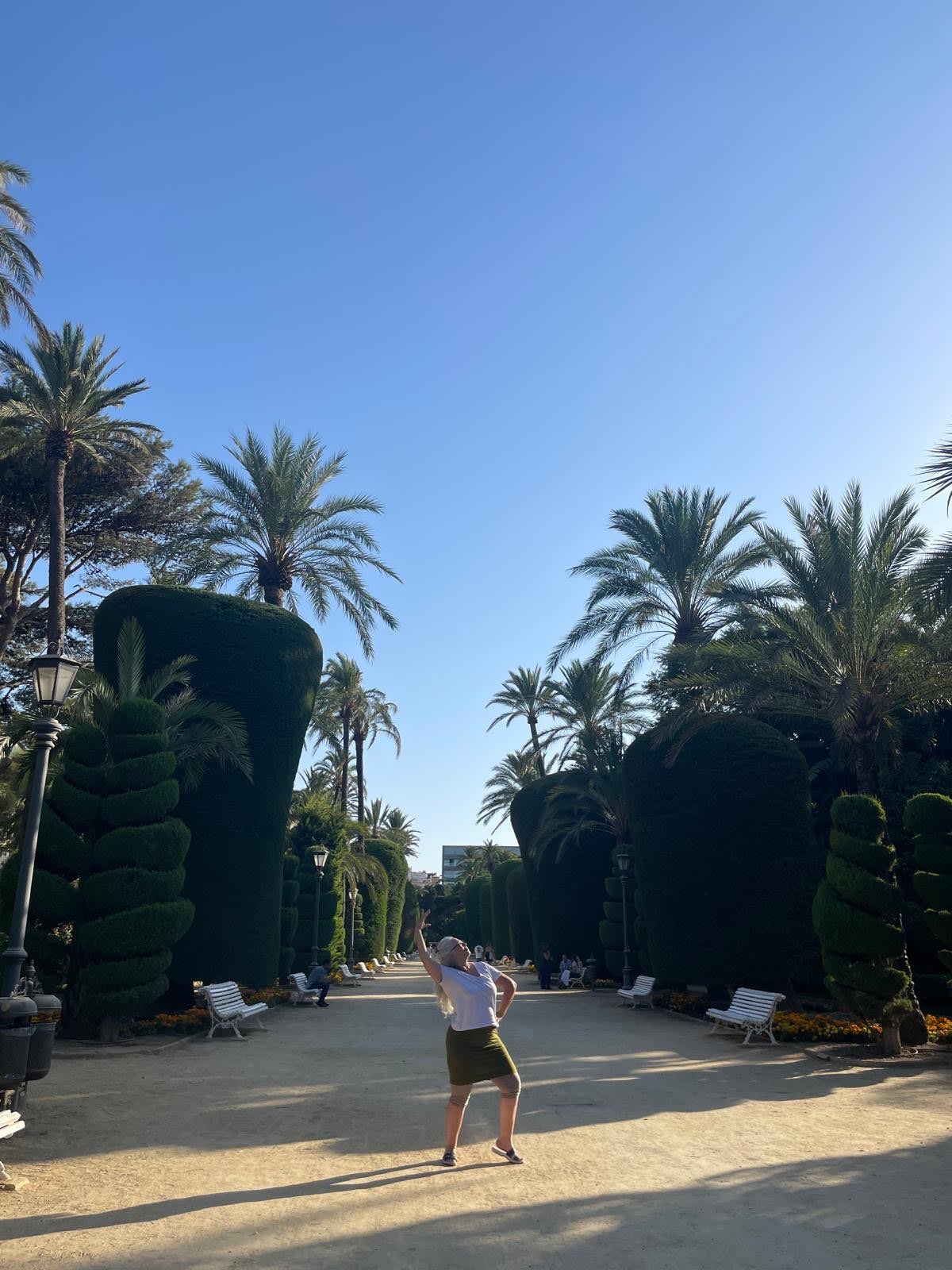
Photo 3 Me in El Parque Genovese, Cadiz
-ExpoFlamenco: https://expoflamenco.world/revista/manuela-carpio-y-la-fiesta-infinita/
-https://en.wikipedia.org/wiki/Concurso_de_Cante_Jondo
.png)

.png)

COLABORA
Brinda el poder transformador del flamenco a todos. Tu donación marca la diferencia.

