Homenaje to Ana Galindo
Tags
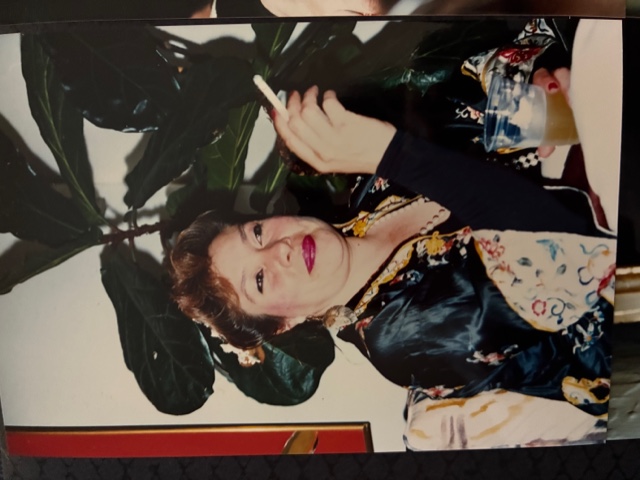
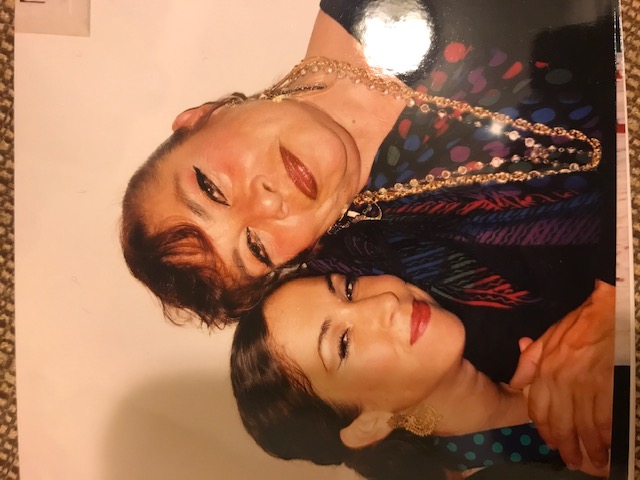
Ana Galindo was not my first flamenco teacher, but she was the first to put me on the stage. She taught without any pretense or exams. Her driving direction was exciting and authentic, her compas supreme. I was doing a babe-in-the-woods-palmas to a twelve-count, all square and academic, with accents on 6-8 10, and she says: How about some 7-8 gitano flavor? Somehow she knew I was ready to understand that. Though Ana taught countless dancers, she also encouraged and developed guitarists and percussionists. If someone played congas and wanted to be in the line-up she would put him in. Flute, bass, cajon, whatever, if you had talent, you were in the line-up. Of course it didn’t hurt if you looked good. We dancers were always wearing various un-matching costumes, but somehow there was always an overall theme, whether it was velvet, or metallic tissue lamé, or the color green. When we would sweep out onto the stage at the Courthouse, two by two, with so much flare and panache, it must’ve been impressive. Pacific Action Dance Theater! Que GARBO tuvo la Faraona de Califas! Con su Elenco! Line up: Bulerias-BAM!
And for those of us in the entourage, what really, really fun nights!! OMG! The craziest. Still all dressed up in our flamenco finery and ready to cause escandalo anywhere we were allowed. Back in those days there were live bands and mariachis all over the downtown area, and it wasn’t a horrid, pressing crowd of 5,000 drunken tourists, either. We had a home base at Papagallos on the De la Guerra Plaza for years. There were many friends and places to hang out around downtown, including my dad’s art studio. For a while Anna had a second floor apartment actually ON State Street, with a window from where one could hear the mariachis and watch the parades.
Everyone was encouraged to dance and sing and play, naturally. For the last several years of Anna’s life, while she was living on Castillo near Carrillo, she hosted a party at Mel’s Bar, right after the Fiesta Pequeña, where they let us take over the outside patio. Of course there was always drama. I recall one night, very late, at what was Casa Blanca downtown, on lower State. We needed the ladies’ room and were trying to get past wall-to-wall chairs full of people drinking, eating, talking, smoking. Ana’s bata (with huge gold lamé polka-dots, stapled onto the bata) got stuck between two chairs and she’s yanking it, and jostling; the lady protests “Cui-DADO! Tengo Menudo!” We cracked up about that afterwards, for years.
We’d get home, four nights in a row, at 2-3-or 4 in the morning. One Sunday, my dad woke up Ricardo and I way earlier than I’d’ve liked and he says: “I got you a brunch show at the Fox Arlington Cafe”! What!? We were exhausted and things didn’t go well. I put on hand lotion before my Caracoles con Abanico and then, on my first cambio de peso, with Roberto Amaral’s company all standing around the edge of the place, like a bunch of crows with their black, black hair, my fan goes flying out of my hand. It flips and flies way down off the raised stage and under a bush, opposite the stage steps. I had to finish that dance with my poor right hand fingers snapping open and closed, pretending to be a fan! HAHAHA!
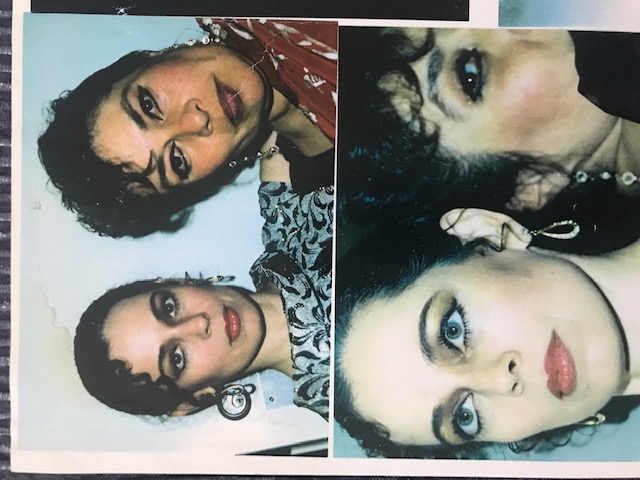
Ana put me in many, many of her shows. Sometimes we would even get paid! She always had beautiful, fun, talented dancers and musicians. She had so much STYLE! As did her tribe. Whenever I had a gig dancing in Santa Barbara the first person I needed with me was Ana Galindo. Her compas was incomparable. First, I marveled at her her kick-ass, no frills choreography. Then I heard her palmas, and how she clicked her tongue in her mouth in contratiempo. The steps we did with Anna were drilled into us, and they have served me well as a professional for many years. They became muscle memory. I’m so grateful for her generously pouring that knowledge into me. Our friendship was priceless to me. We GOT each other. Our sense of humor, our love of costumes.
My dad used to get so jealous of her. I’d come flying in from NYC, arriving in Santa Barbara on the 2pm plane, immediately abandon him and go straight over to the courthouse to learn Anna’s routine and get ready to go on that night. Because every thing was always last minute. The line-up got changed all the time. With that kind of baseline you are ready for anything and always on your toes, with all 5 senses attuned.
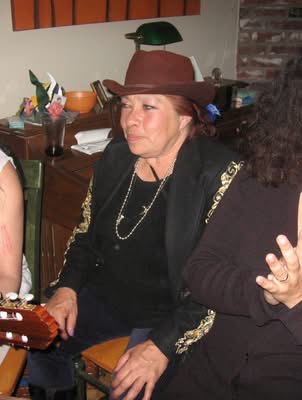
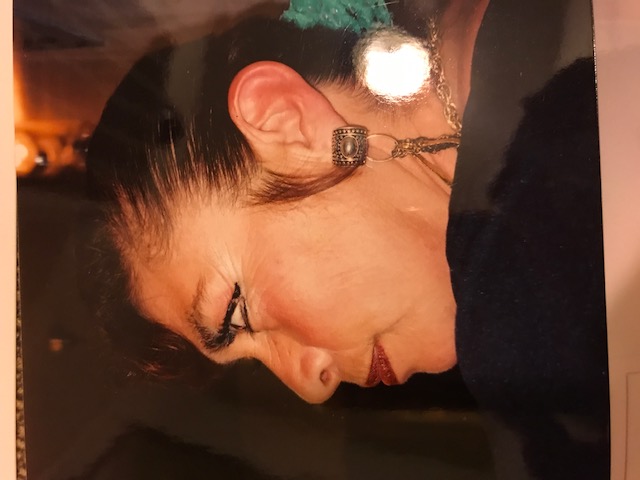
Friends, you know what I mean! Her jaleos, palmas, cajon, and her Dhumbek. Always steady, secure, seguido. Unafraid to be different. One of the most authentic and flamenco people I ever met. Our beloved and respected master of the flamenco, Ana Galindo, (1942-2026) ‘La Faraona De Califas’, died on July 9th in Santa Barbara, CA.
Ms. Galindo started her musical studies very young, at her parents’ insistence. In that era, every moderately successful home contained a piano, and the Galindo home was no exception. Anna started training at age 3 and her teacher said that she had “an astute ear”. Developing an interest in pitch, volume, and rhythm, she naturally became interested in dance. Through her musical skill, a dance practice was born.
She studied years of Ceccheti ballet with the nearly blind, elderly Mme. Rosella Frey at the 1920’s era Chapman Court. She trained extensively in Spanish Classical, Mexican Dance and Flamenco with Trinidad Goñi, over the old Capezio Dance store, in downtown LA. She trained in Flamenco Puro with Luisa and her father Antonio Triana, who ended up in California after fleeing the Spanish Civil War.
An early photo shows Ana dancing, in a costume by her mother, at a Hollywood luncheon honoring Carmen Amaya. Anna, aged 10, had been singled out of dozens of dancers to represent her school. Carmen saw herself in Ana, and became enamored. The next day a cab called for the little girl, and took her to a mansion in Los Feliz. She was told to knock on the door. The person who opened it was none other than Carmen Amaya, and so Ana started a series of private classes with La Capitana herself.
While still at the Manual Arts Public High School, Ana was hired to teach ballet to the LA Dodgers, to increase their dexterity. She studied the arts at Rio Hondo Community College in Whittier, 1973-75, where she assisted Dorothy Brewer, the Modern Dance teacher. For many years Ana toured with Luisa Triana throughout the Southwest with high calibre artists such as dancer Cruz Luna, guitarist Mario Escudero and cantaor Chenin de Triana.
She worked on movie sets at Paramount with John Wayne and Tony Curtis, and assisted the legendary Hollywood costume designer Edith Head. In LA, as an adult dancer, Anna achieved such notoriety such that all the flamenco guitarists of that era wanted to work with her, like Benito Palacios and Darien Cabral. She partnered Juan Talavera for 17 years, on tour and in the LA flamenco tablaos like The Purple Onion and El Cid, and later at the Spaghetti Factory in San Francisco. She taught for LA Parks & Rec where Maria Bermudez’ first profesora de baile flamenco was Ana Galindo. She taught classes out of her home in Pico Rivera, which were always so packed that people had to be turned away.
How did she end up in Santa Barbara? The year was 1975. Galindo was at the height of her career in her late 20’s. Her parents had just purchased a new home in El Monte, but then her mother fell seriously ill. Ana was caretaking her own mother, teaching, touring, performing, and raising two small children. In Dallas, Tx., there was a club called Daddy’s Money, a very exclusive steakhouse, full of rich oilmen. They had a 5-star flamenco dinner show, featuring artists from Spain: 3 shows nightly, 7 nights a week. The summer season was underway when a Spanish dancer suffered a broken leg. Being too late to bring a dancer from Spain; guitarist Benito Palacios recommended Anna Galindo. Anna hired her friend Dolores to drive them all to Texas and to nanny Ana’s kids, 8 and 11. The next day they all piled into Dolores’ Ford Pinto and headed East. The accommodations were in a luxury complex with 5 swimming pools. When the contract was up, with all the money she had made, Ana decided not to go back to El Monte. The Greyhound bus driver heard the children say they wanted to live near the mountains, and the ocean. He said “Ma’am, there’s only one place that has all that. It’s Santa Barbara.” She said: “Three tickets, please.”
Fifty-one years ago she brought her family to SB. Ana dedicated her life to dance, music and art, and made a significant contribution to the culture of Santa Barbara Old Spanish Days Fiesta. She had a tremendous influence on that annual mid-summer festival by training hundreds of aspiring dancers, and bringing her own group of performers to perform in same. For years she taught at SB Ballet Theater under Tamara Usher, also for Antonette Lopez, Kathy Cota, and Rosemary Cruz. She was Lakshmi Basile’s profesora before Lakshmi went to live in Sevilla and became one of the most highly regarded American flamenco dancers in Andalusia. The Zermeños started as teens studying flamenco with Ms. Galindo, and now Daniela Zermeño directs one of the biggest academies in SB. Breaking boundaries while promoting flamenco puro, Ms. Galindo was the first to bring male dancers to the stages of Fiesta, the first to wear a bata de cola or employ live musicians in her group “Pacific Action Dance Theater”. The gate-keepers at the Santa Barbara Courthouse said “No, you can’t bring live musicians to the stage here” and she responded, “This is authentic flamenco. This is how it’s done. If you won’t allow the musicians onstage, we won’t be performing.” And the world of Old Spanish Days Fiesta shifted. Twenty-two dancers trained by Ms. Galindo won the coveted title of Spirit of Fiesta.
She made strong connections everywhere she went, with people from all walks of life. She taught at Casa de la Raza, at Franklin School Library, for SB Parks & Rec., at Dance Warehouse, at the Dance Hub, at West Side Dance, and later at Oak Park, at Eling’s Park, and even on the platforms at the Bird Refuge. She did performances and gave classes at Pershing Park. She did not to charge for her classes because she called them rehearsals, not classes.
The City of SB commissioned her to create a 250-ft mural at the Franklin School Library. They gave her the paint and the kids who were in trouble for doing graffiti. It was an explosive situation: members of rival East Side/West Side gangs would both visit her home on Cota St. on Friday nights, but they practiced self-control out of respect for Ana.
Galindo painted 100’s of artworks in acrylic and made hundreds of sketches and cartoons, rich with her creative sense of humor. No art school for her, she learned by observation and practiced her own methods. In saturated colors, her paintings are figurative, full of motion and decorative textures. Subject matter is friends an flamenco dancers; real people in her life rendered fantastically. Combining her two great loves, she took her dance and put it into her paintings
She was one of a kind. I will always miss her deeply.
Works Cited/Further Reading
.png)

.png)
.png)
SUPPORT
Ignite the transformative power of flamenco for all.
Your tax deductible donation goes directly to artists and programs. We can't do it alone. Your support makes all the difference!

