25th Annual Flamenco Festival, NYC 2026: Week One

Tags
25th Festival Flamenco NYC 2026:
Week One
I got back to New York just in time for the 25th Annual NYC Flamenco Festival, produced by Miguel Marin in partnership with New York City Center Theater and the World Music Institute. The Quadranscentennial theme was presented through the lens of the love affair between New York and Flamenco. According to Sr. Marin (and the facts!), NY has been profoundly affected by the art form, while the flamencos in turn have been influenced by what they found, and continue to find, in New York. Within this framework, we were treated to performances by big ticket FF favorites like Sara Baras and Eva la Yerbabuena, but also shows in more humble settings, as well as lectures and presentations honoring Sabicas, Mario Escudero, La Argentinita and Carmencita—the flamenco dancer from Almeria, who took the city by storm in 1889. As usual, the 20-day marathon gave us cause to wear our fanciest clothes, run into dear colleagues at the theaters, left us sated with the authentic traditional, updated on current trends, and pleasantly exhausted.
.png)
Video resumen del espectáculo 'La confluencia', que Estévez & Paños y Cia presentan el 18 de enero de 2026 en el Festival Flamenco de Nimes. Video credit: Expoflamenco.
Estévez/Paños y Compania: Confluencia on Feb 27th at NY City Center Theater
Five versatile dancers, including Alberto Sellés, Jorge Morera, and Jesús Perona, plus the two named directors, shared a stage in a non-stop feast of technical skill, expressed with wit and emotion and accompanied by three musicians (guitar: Claudio Villanueva, cante: Al-Blanco and percussion: Lito Manes) in a stream of wide-ranging musical selections. According to the program, they “draw inspiration from the ancient roots of flamenco…including influences from European, Roma, Jewish and African cultures.” Through a series of vignettes on a mostly darkened stage, they danced with expertise in flamenco, contemporary and classical dance.
It was good to see director Estévez, a hefty man, take a prominent role, seated for one solo and later featured de pie in special lighting. Too often the larger dancers are not shown, and certain talents never get the chance to shine. His worth is unmistakable, with lightning sharp, musical escobillas, expressive braceo y manos, and a director’s voice on the mic that pulls everything together. One section, Count Helios’ Romance or the Hindered Wedding, a virtuosic duet between Sellés and Paños, ended with an image reminiscent of the Pieta. The dancers grouped, re-grouped, flung themselves onto the floor and sprang into the air, executed flawless turns (we counted Paños in set of 8), exquisite extensions and wild blends of flamenco and contemporary dance. As currently in fashion, costume changes were minimal (from all black, to white tops) and happened on stage. Towards the end of the concert the music morphed between Zarabanda, Tangos, and Zambra with the dancers repeatedly stretching their shirts to cover (and uncover) their heads and faces, traveling on their knees and flapping their hands wildly. This produced for me a chilling effect, reminiscent of the 13th Century Choreomania which swept Northern Europe, when masses of the general populace danced tirelessly, until some actually dropped dead from exhaustion.
The darkness felt ever present, even within powerful moments and an upbeat finish, the arrangements found the sinister even within the bodies’ expressive joy. I was once again impressed by the never-ending variations possible in the art of dance. I loved the music (it was no surprise to learn that the cantaor/scholar Rafael Fajardo, El Falo, was instrumental in musical selections), was in awe of the dancer’s stellar technique, and felt the director’s arc was masterful at weaving together a provocative and coherent evening’s entertainment. A successful attempt to use the flamenco tradition to create something new that yet remains based in that same root art form.
.jpg)
Saturday, Feb 28th,
La Argentinita in New York/New York in La Argentinita at the Bruno Walter Auditorium
This lecture presentation & live performance thoroughly explored the trajectory of Encarnacion Lopez Fulvez, “La Argentinita” (1897-1945). Born in Argentina, she lived in Spain for most of her life, but had many engagements in NYC. In Spain she developed an important career, “becoming one of the most relevant personalities in the Silver Age of Spanish culture”. A singer, dancer, actress, and choreographer, she collaborated with some of the greatest artists of that period: Ignacio Sanchez Mejias, Jose Iturbi, Leonid Massine, La Malena, La Macarrona, F. Garcia Lorca, and Salvador Dalí. Presenter Jose Javier Leon spoke with eloquent humor on the achievements of this remarkable woman. Supported by slides, recordings and live performances by Irene Morales, and Rocío Márquez, he illuminated her place in the evolution of Flamenco and Spanish Dance. To hear the recording of La Cafe de Chinitas that she and Lorca made circa 1920’s in NYC gave me goosebumps. Encarnacion toured many times throughout Europe and Americas with her company and lived in exile in NYC from 1939 until 1945. After she passed away, her sister, the dancer Pilar Lopez, carried on her legacy in Spain and New York. This legacy thrilled me to the core since my first maestra in NYC was none other than Maria Alba, who toured with Ximenez/Vargas, the group that remained of Lopez/Ximenez after Pilar died. Overall, a complete and interesting presentation.
Sra. Morales danced with charming and precise style in a pale turquoise bata, and cantaora Rocío Márquez, who “blends tradition and experimentation” sang perched on the edge of the stage’s apron (quote source: festival program).
Flamenco Festival 2026, Gala Flamenca Directed by Manual Liñan with MANUEL LIÑÁN, EVA YERBABUENA, EL FARRU & JUAN TOMÁS DE LA MOLÍA. 📹 Paco Millán
Gala Flamenca on Feb 28th, NYCC
Directed by Manuel Liñán, this show opened with the four dancers in a dynamic Caña and featured five distinct chapters, each focusing on a different master of the genre. First up, we had three powerful singers (Manuel de Gines, Juan de la Maria and Sebastian Sanchez) supporting and inspiring the brash young new-comer Juan Tomás de la Molía. Accompanied only by the complexities of the palmas and the voices, and performed down at the front of the stage, he did some of the most charming, tasty, serious and jaw-dropping escobillas por bulerias that I’ve seen lately! Compact, yet lithe of physique, both his chops and his humor are a revelation. Keep an eye on this one; he was featured in this year’s Gala, at the Fiesta Flamenca at the Baryshnikov and in Liñan’s triumphant show at CC last year; Muerta de Amor.
With a good use of stage-craft Liñán and Yerbabuena did a dark duet, mostly in silhouette on an indigo backlight psych, with the guitarists Paco Jarana and Francisco Vinuesa joined by percussionist Daniel Suarez on the darker right-hand side. This masking of the musicians focused our attention on the dancers, but alas, I felt that the number featured the movement tropes of a difficult partnership and left me unimpressed. It seemed included simply to provide variation in a concert of solos.
Better to focus on El Farru’s dynamic Siguiriyas, wherein he accompanied himself with a bastón (that got its very own costume to match his shoes: a fringed black patent-leather skirt). The man properly represents his dynasty of powerhouse artists. His sparse and measured pace during the cante was balanced against bursts of taconeo during contestaciones and escobillas, embodying the trademark Gitano sensibility of which I never tire. Toward the end of his number, winding down the dance drama, he took a specially lit seat to share some toque in a nice Siguiriyas of his own, proving his skill in another aspect of flamenco. I underestimated the impact he could provide onstage with a master such as Jarana, and I was pleasantly affected.

I have always deeply admired Manuel Liñán from the moment I set eyes on him in the 2010 FF performing in Carlos Chamorro’s Dressed to Dance, the site-specific dance/runway show at the Guggenheim with historical costumes designed by Picasso and Salvador Dalí. His phenomenal Viva! Gained wide notoriety and his Muerta de Amor was the best show I saw at the 2025 festival. But his performance this year, although of a brutal beauty and joy, it left me… not so stoked. Not long ago, he closed the Gala with a Solea with bata and manton that had me in tears after the first llamada. But his Alegrias this year featured non-stop tricks; too much mantón and stop-poses engineered for applause. It seemed repetitive and out of tune with the flowery delicacy I associate with this palo. Perhaps to be fair, this is his intention. Four, no FIVE verses, were sung, each more macho than the last. Footwork breaks, yes, but none of the classic escobilla section and including a silencio that trailed off as the ending. I realize that modern flamenco fashion no longer finishes with a big bang. The cada-ching-poong endings we did for years are now considered passé. But the fadings-out have become so commonplace that they, in turn, now need an update.
Mara Rey is everywhere! I saw her in Sevilla, in California, and now twice, in NYC. This is the hardest working woman in flamenco today, and for good reason, because she is well worth seeing. In the Gala she performed a majestic torch song composed by Mexican Lolita de la Colina, immortalized by Cubana Olga Guillot, and later styled as a bulerias by the one and only Lola Flores. Mara sang this passionate cuple in a resplendent red costume, her vocals and the arranque of her patadas dominating the stage in nobility. For me, she was the best thing in the entire festival, here at the big theater Gala, but even more so up close with that same tour de force at the more intimate Baryshnikov Fiesta Flamenca on March 4th.
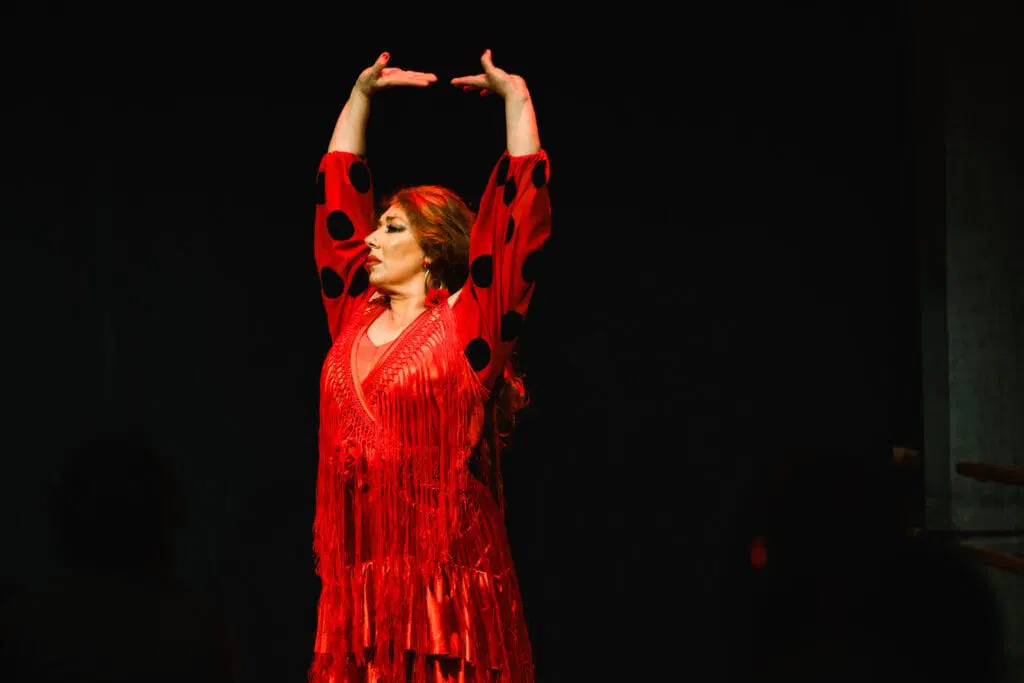
As for Eva la Yerbabuena, call me crazy, but I have never been overly fond of her dancing. Her skill, yes, her braceo lovely, but that does not create a goddess on the level of Manuela Carrasco. I watched a video of her (Eva) in a wonderful Solea por Bulerias (YouTube), but I honestly haven’t bought tickets to her shows for the last few festivals. As a dancer/teacher, I cannot afford all that I’d like to see, so I must pick and choose. The opening was lovely, with Paco (her husband) Jarana’s beautiful toque, but I am unmoved by much of her baile. I once had a theater teacher who urged us to “see the art in ourselves rather than ourselves in the art”. I see a bit too much of la Sra. in this iteration. I tuned out, especially at the end, which featured a billion too-long escobillas. I’m done and tired! I could watch a subtle Jerezano artist like Pepe Torres for a good lot longer precisely because he doesn’t bang us over the head with endless footwork!
This video is from 2025, COMPAÑÏA EVA YERBABUENA. "Yerbaguena. Oscuro Brillante" video credit: Flamenco Festival
Speaking of which: when is the current presentation style that is a two hour show/no intermission/discomfort for the audience going to go out of vogue? For the Gala it was somewhat less onerous because of the variety, but Estévez/Paños was a wee bit long and Sara Baras was even more extended! We the public do have a limited capacity for staying seated, and personally I enjoy having a break to get a drink and socialize! Sara Baras’ review will be forthcoming in the next issue.
Joe’s Pub Saturday, Feb 28th, Irene Morales RAW
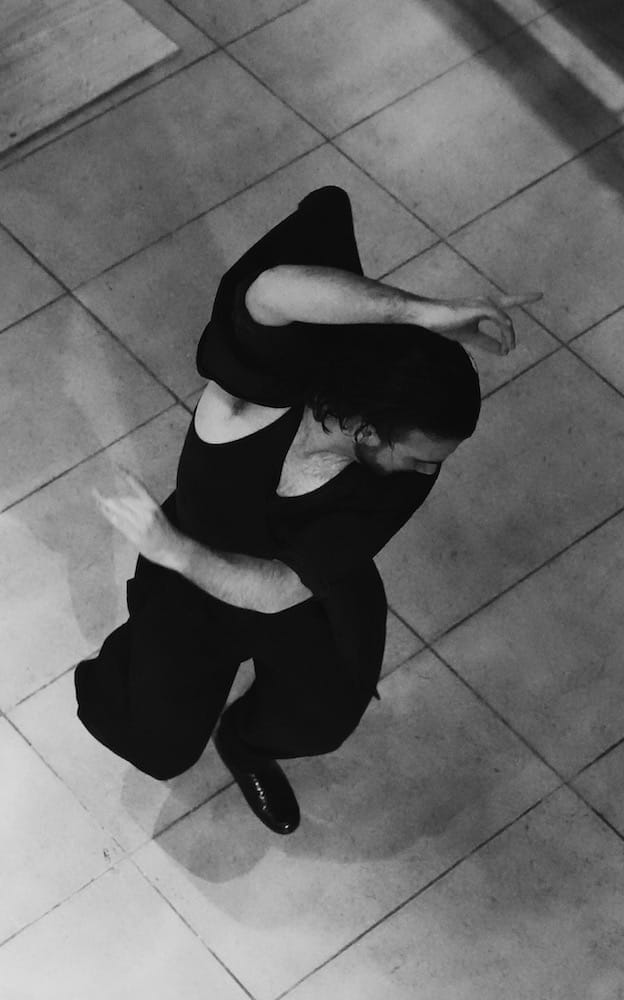
Getting down to Joe’s Pub after the Gala was not a great plan, but the way the events were scheduled made it necessary to do this kind of rushing around town. We arrived 30 minutes late and Irene had already danced her Tiento Electronico with the turquoise/orange bata in which we saw her dance earlier in the day at Lincoln Center. As we entered she stood onstage in a suit of yoga pants and sports bra and then danced her Guajira. She then proceeded to don an sleeveless orange shift-type dress, wrapping an extra-long black music cable around herself to create a waistline, perhaps symbolizing a symbiosis between herself and the music, a blending of electronics with the dance. Antonio Chavez, an electronic musician, sat at a keyboard/sampler/DJ set-up at the back corner of the stage, triggering compás tracks and some interesting drone-type sounds, while later Al-Blanco, the singer, sang a masterful Romance. We saw Zapateado en Re- which Irene danced as a tribute to Sabicas. Juan Fermin Fernandez, the virtuoso guitarist, had the singer set up an old school metronome to which he played a beautiful, complex, fast number, while the cantaor sat at his feet.
Morales sees herself rightly as an untraditional artist in this genre. It is so tricky to get out of the rigid structure of this art form without becoming something very different. Her footwork is clean and strong, her breaks musical and interesting, her embodiment of flamenco style and grace is real. For me the most successful at genre-bending was her last number. Al-Blanco sang a tasty Tangos into a mic on a stand, still singing he stood on a chair, a piece of furniture which was later inverted, and then upon which Irene reclined… he left the stage and returned, and each time he re-entered he continued singing where he had left off, exited and re-entered, sang and exited and the mic still projected his voice. She went and covered the mic with her hand and the cante stopped. She let go and it started up again, and repeat, and repeat.
It was a lot and I am still recovering. I hope that you might look forward to my musings on the second week of the Festival in the May edition of Afición, the FAI digest, in which I am honored to be included.

Works Cited/Further Reading
Main Image: Gala Flamenca featuring dancer Juan Tomás de la Molia, directed by Manuel Liñan. Photo by Christopher Duggan. Credit: flamencofestival.org
Gallery Image 1: http://flamencofestival.org/galeria-3/, Image 71 of 84
Gallery Image 2: http://flamencofestival.org/galeria-3/, Image 28 of 84, featuring Irene Morales RAW at Joe's Pub, NYC.
All Images from flamencofestival.org/galeria-3/. Various Photographers
.png)


.png)
.png)
SUPPORT
Ignite the transformative power of flamenco for all.
Your tax deductible donation goes directly to artists and programs. We can't do it alone. Your support makes all the difference!

